
Beyond the Drug Licence: Why Pharma Companies Needs Professional Certification and Accreditation Verification Too
Updated: Sep 11
-By Samik Das | Blockchain Solutions, VARA Technology
A contract laboratory sends over a technician's calibration certificate. The compliance officer then checks if the certificate exists, if the name matches and the date hasn't expired. Nobody asks a harder question: is the body that issued this certificate itself recognised to issue it.
That question sits outside the usual pharma compliance conversation, which tends to fixate on drug licenses and manufacturing approvals. But a pharmaceutical operation runs on a much wider set of credentials, and most of them never touch a regulator's desk.
The credential ecosystem hiding behind the licence
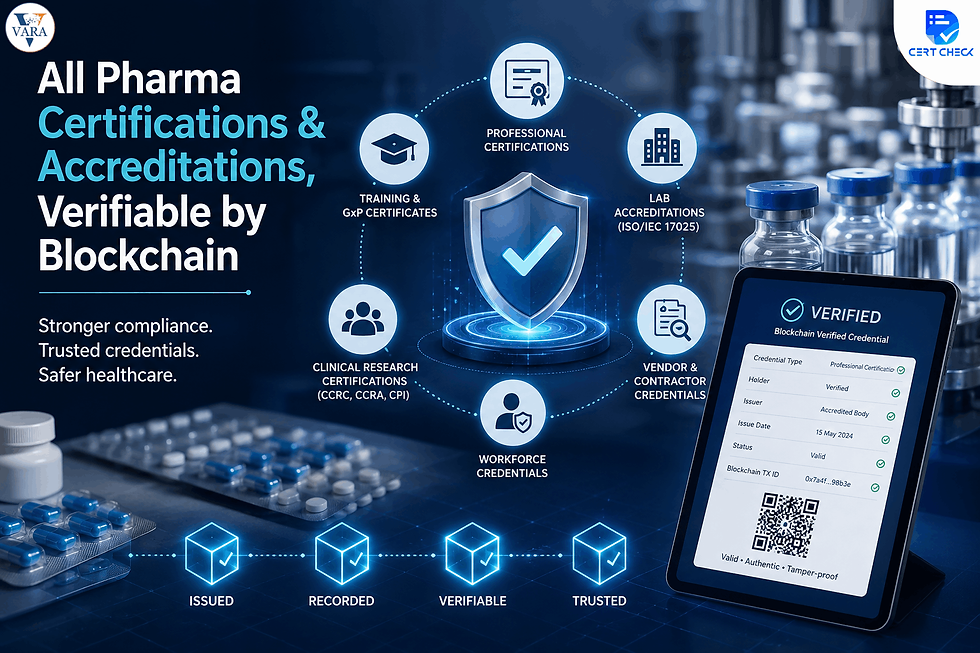
Clinical trials depend on certified coordinators and monitors. ACRP, the Association of Clinical Research Professionals, administers separate credentials for each role: the CCRC for clinical research coordinators and the CCRA for clinical research associates who monitor trial sites, alongside CPI for principal investigators and the role-agnostic ACRP-CP. Contract laboratories running stability studies or drug testing need personnel who meet defined competence requirements, and in India, NABL, the National Accreditation Board for Testing and Calibration Laboratories, accredits testing and calibration labs against the ISO/IEC 17025 standard.
Then there's the workforce layer that rarely gets discussed: contractors doing validation work, vendors supplying quality-critical components, and trainers certifying GxP refresher courses. Vara Technology's work on verifying vendor and contractor compliance credentials in manufacturing shows the same pattern playing out outside pharma. Each of these roles carries a credential. Almost none of them get checked the way a drug licence does.
What is the difference between certification and accreditation?
Certification confirms that a person or a process meets a defined standard. Accreditation confirms that the body doing the certifying, or the laboratory doing the testing, is itself competent to do that job. A clinical research associate holds a certification. NABL grants accreditation to the laboratory that associates might later work in. Some certification schemes go further and have the certifying body itself accredited, typically under ISO/IEC 17024, the international standard covering bodies that certify individuals. Not every certifying body pursues this, and whether it's expected depends heavily on the scheme and sector. But where it applies, a compliance team that verifies only the certificate and never considers who accredited the certifier is checking half the chain.
The gap nobody is auditing
This is where verification quietly breaks down. A training provider can issue a GxP completion certificate that looks entirely professional without holding any recognised accreditation itself. A calibration report can carry a lab's letterhead without that lab holding current ISO/IEC 17025 status. Compliance teams verify the document. They rarely verify the issuer's own standing, mostly because there has never been a fast way to do it.
Multiply this across every contractor, every trainer, every laboratory a mid-sized pharma company works within a year, and the number of unverified links in the chain grows fast. The scale problem isn't unique to pharma either; This is where verification quietly breaks down. A training provider can issue a GxP completion certificate that looks entirely professional, even when the provider's own recognition or accreditation status has not been independently checked. A calibration report can carry a lab's letterhead without that lab holding current ISO/IEC 17025 status. Compliance teams verify the document. They rarely verify the issuer's own standing, mostly because there has never been a fast way to do it.
The same problem extends to the credentials behind regulated workforces. Pharma companies rely on employees, contractors and other professionals whose qualifications and certifications can directly affect compliance and operational risk. As VARA Technology has explored in its analysis of credential verification in pharmaceutical hiring and compliance, a document can look legitimate while the underlying verification process remains difficult to audit. The question is not only whether a certificate exists, but whether the organisation relying on it can establish where it came from and whether its status can be independently confirmed.
What verifiable digital credentials change
A verifiable credential, in the technical sense defined by the W3C's Verifiable Credentials Data Model, is a set of claims made by an issuer and secured with a cryptographic proof, so a verifier can confirm authenticity and detect tampering without needing to contact the issuer for every single check. Applied to pharma's wider credential ecosystem, the idea is that a clinical research certification, a lab technician's competence record, or a contractor's training credential can be issued in a form that's traceable back to its issuer, with a timestamp attached.
What better verification looks like
The answer is not to ask compliance teams to manually investigate every certificate from scratch. It is to make credentials easier to issue, manage and verify from the moment they are created.
How CertCheck Helps Pharma Organisations Build a More Verifiable Credential Ecosystem
That is the problem CertCheck is designed to address. Institutions and organisations can issue digital certificates with a verifiable record behind them, while employers, compliance teams and other authorised verifiers can check whether a credential is authentic, valid and has been revoked when necessary. Instead of relying solely on a PDF, email confirmation or a document that can be edited and forwarded, the verification process can be tied to a credential record created by the issuing organisation.
For a pharmaceutical company, that could mean a more structured way to manage the credentials of employees, contractors, vendors or other professionals whose qualifications matter to compliance and operations. The platform does not replace the authority of a certification body, regulator or accrediting organisation. It helps organisations create a more reliable verification layer around the credentials they issue and the credentials they need to check.
This is the layer CertCheck operates in. Institutions and companies can use the platform to issue certificates onto a blockchain ledger, and verifiers can check authenticity in real time rather than waiting on manual document review. Officially, that includes real-time blockchain validation, bulk verification for high-volume checks, an audit trail per verification, and revocation management for credentials that are later withdrawn. It's worth being precise about what this does and doesn't do: CertCheck can only verify a credential against the record an issuer has put on the platform. It doesn't automatically reach into every professional body's or accreditation body's own external registry, so its value depends on the relevant issuer having brought that credential onto the system in the first place.
The chain is only as strong as its weakest link
Pharma compliance has spent years hardening the licence and the regulatory filing. The wider network of certifications, accreditations, and workforce credentials sitting underneath that filing has had far less scrutiny, mostly because checking it by hand across dozens of vendors and contractors was never practical. As more issuers move credential issuance onto verifiable, blockchain-anchored systems, that gap starts to close. Organisations that start treating certification and accreditation checks as seriously as licence checks will be the ones with fewer surprises during an audit.
FAQ
How can companies verify a professional certification?
The most reliable route is checking directly with the certifying body, either through its own registry or lookup tool where one exists, rather than relying on the visual appearance of the certificate. Where the issuer has adopted a digital or blockchain-based verification system, that check can happen in seconds instead of through a manual email or phone inquiry.
What are verifiable digital credentials?
Per the W3C's Verifiable Credentials Data Model, a verifiable credential is a set of claims from an issuer, expressed digitally and secured with a cryptographic signature, so a verifier can confirm authenticity and detect tampering without contacting the issuer for every check.
Does a certification body need to be accredited itself?
Not always. Some personnel certification bodies pursue accreditation under ISO/IEC 17024, which adds a layer of independent oversight, but this isn't universal across every certification scheme or sector. Whether it applies depends on the specific credential and industry.
Can digital credentials support pharmaceutical compliance?
They can help, particularly by giving compliance teams a faster, timestamped, and auditable way to confirm a credential's origin. They don't replace the certifying or accrediting body, and their coverage is limited to credentials the issuer has actually placed on the relevant platform.
CertCheck offers instant blockchain-backed certificate verification with a full audit trail - built for pharma companies operating at scale. Explore the platform at certcheck.in
If you are still in doubt if your data is safe with CertCheck, let us reassure you that
Blockchain-Powered Trust: CertCheck uses Hyperledger Fabric, a permissioned blockchain, to issue and verify tamper-proof digital credentials.
DPDP-Compliant by Design: CertCheck does not store student or individual personal data, helping institutions maintain privacy and regulatory compliance.
Privacy-First Verification: Only cryptographic proofs are recorded on the blockchain, enabling secure verification without exposing sensitive information.
Secure & Verifiable Credentials: Every credential is independently verifiable, fraud-resistant, and backed by a transparent audit trail for employers and institutions.
Follow CertCheck for practical insights and industry updates:
X: https://x.com/certcheck_in→ LinkedIn: https://www.linkedin.com/showcase/certcheckofficials/→ YouTube: https://www.youtube.com/@CertCheckOfficial Discord : https://discord.gg/acgbRnMWc
If credential trust matters to your organization, we'd love to have you along for the journey.


